Missing teeth are not just an aesthetic problem; they impair chewing function, affect speech, and over time can cause jawbone resorption.
Today, the most permanent and natural solution to this problem is dental implant treatment.
However, the most frequently asked question by many patients is:
How is the implant procedure performed, is it painful, and how long does the healing process take?
Examination and Planning Stage
The Most Important Step Determining Treatment Success
The success of implant treatment depends more on accurate planning than the surgical procedure itself.
This stage involves a personalized analysis process for each patient.
Clinical Evaluation
The dentist first examines the oral cavity in detail.
The number of missing teeth, the condition of surrounding teeth, gum health, and jaw structure are assessed.
Additionally, bite alignment (occlusion) and chewing forces are analyzed.
The goal is to ensure that the implant integrates into oral functions like a natural tooth.
Imaging and Measurement
X-rays and 3D dental tomography (CBCT) are used to determine bone height, width, and density.
These data are digitally analyzed to plan the ideal position and angle of the implant.
In modern clinics, “digital implant planning software” reduces the margin of error to almost zero.
General Health and Risk Analysis
Before implant treatment, the patient’s systemic condition is also evaluated.
Factors such as diabetes, hypertension, heart disease, osteoporosis, or smoking habits are analyzed by the physician.
If necessary, consultation with an internal medicine specialist is performed.
The aim is to ensure the implant is fully compatible with the body.
Surgical Preparation and Anesthesia Stage
Preparation for a Painless and Safe Experience
Implant surgery is performed under local anesthesia, meaning the patient does not feel any pain during the procedure.
The doctor provides detailed pre-procedure information and ensures psychological comfort.
Sterile Surgical Environment
Implant operations are performed in specially equipped surgical rooms with sterile conditions.
All instruments are sterilized in an autoclave, and the surgical area is cleaned with antiseptic solutions.
This minimizes the risk of infection.
Type of Anesthesia
Generally, local anesthesia is preferred. However, if multiple implants are to be placed or the patient experiences high anxiety, sedation or light general anesthesia can also be applied.
This is especially useful for All-on-4 and All-on-6 full-mouth implant systems to increase patient comfort.
Placing the Implant into the Jawbone
The Most Critical Point of the Surgical Procedure
Once planning is complete, the implant placement stage begins.
This procedure typically takes 20–40 minutes and is completely painless.
Incision of the Gum (Flap Raising)
A small incision is made in the gum at the site where the implant will be placed.
This allows clear visualization of the underlying jawbone.
Creating the Bone Socket
The doctor uses special surgical drills to create a socket suitable for the implant diameter.
This process is performed with millimeter precision, as the implant’s angle directly affects chewing forces.
Some clinics use a surgical guide at this stage to ensure precise digital placement.
Implant Placement
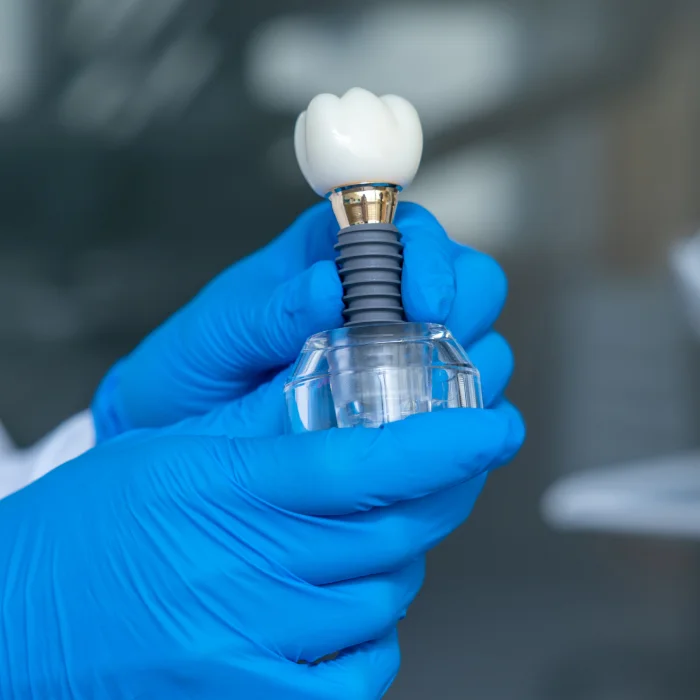
The titanium screw-shaped implant is placed into the prepared socket.
This material is fully biocompatible and will not be rejected by the body.
After the implant is secured, a temporary cover is placed, and the site is closed with stitches.
First 24 Hours Post-Operation
The patient rests briefly at the clinic after the procedure.
The doctor prescribes painkillers and antibiotics.
Usually, the patient can return home the same day and consume soft foods.
Osseointegration (Healing) Process
The Period When the Implant Fuses with the Bone
During this process, bone cells around the implant attach to the titanium surface and form new bone tissue.
This biological connection is called osseointegration.
Duration and Stages
Lower jaw: Approximately 2–3 months
Upper jaw: 3–5 months.
In patients with low bone density, this period may be slightly longer.
What Happens During This Period?
- Stitches are removed within 1 week.
- A temporary prosthesis can be placed to maintain aesthetics.
- The doctor may take periodic X-rays to monitor healing.
Importance of Osseointegration
This process determines the durability and stability of the implant.
Successful osseointegration ensures the implant is as strong as a natural tooth root.
Abutment and Impression Stage
Connecting the Implant to the Tooth
Once the implant has fully integrated with the bone, an attachment called an “abutment” is placed.
This piece allows the prosthetic tooth to connect to the implant.
Second Surgical Procedure
A small incision is made in the gum to remove the temporary cover on the implant.
The abutment is screwed in, and a few days are allowed for the gum to adapt naturally around it.
Impression Process
The dentist takes impressions considering the tooth’s shape, color, and harmony with adjacent teeth.
These impressions are sent to the laboratory, where a custom porcelain or zirconia tooth is prepared.
The lab process usually takes 5–7 days.
Placement of the Prosthetic Tooth
Visual and Functional Completion of Treatment
The prepared prosthetic tooth is placed on the abutment using a special attachment system.
The tooth is colored to match the other teeth aesthetically.
Types of Prostheses
- Single-tooth implant: Applied to replace a single missing tooth.
- Bridge-type implant: Preferred when several adjacent teeth are missing.
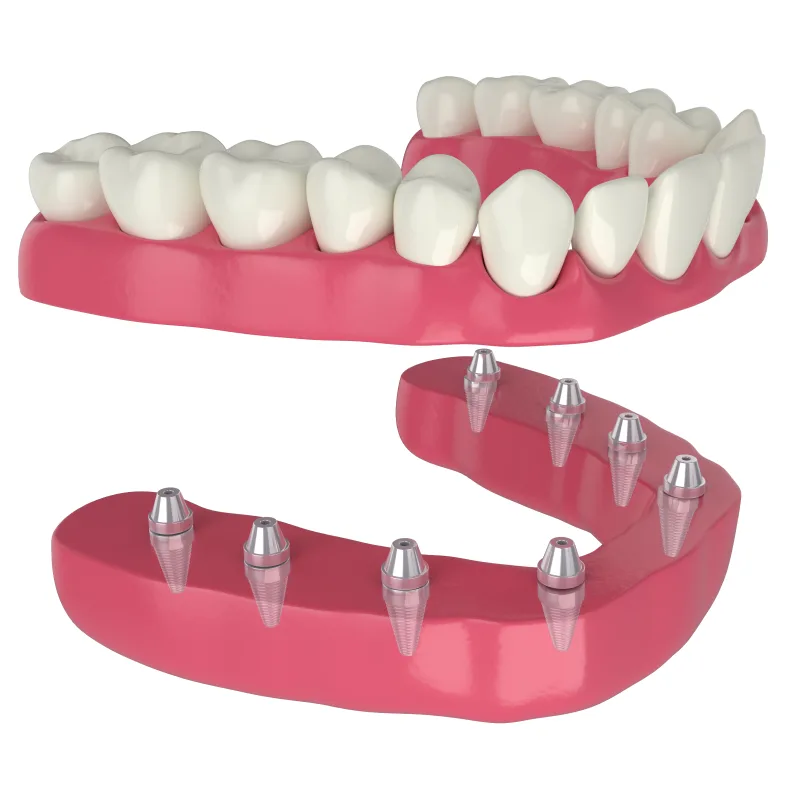
- All-on-4 / All-on-6 systems: Advanced systems where all teeth are renewed with fixed prostheses.
Final Checks
After the prosthesis is placed, the doctor:
- Checks chewing balance,
- Monitors gum adaptation,
- Makes minor adjustments if necessary.
After this stage, the patient regains natural tooth sensation, chewing, and speech function.
Post-Implant Care
The Key to Long-Term Use
Implants are long-lasting, but regular maintenance is essential to sustain their longevity.
Daily Oral Hygiene
- Brush your teeth twice a day.
- Use dental floss or interdental brushes.
- Use mouthwash to prevent bacterial buildup.
Dietary Habits
Avoid very hard or hot foods during the first week.
After healing, all types of foods can be consumed comfortably.
Regular Dentist Checkups
X-ray checks around the implant every 6 months help prevent early-stage inflammation or bone loss.
Possible Complications and Risk Management
As with any surgical procedure, some risks may occur during implant treatment:
- Infection: Can develop if the surgical site is not kept clean.
- Implant failure: If osseointegration is incomplete, the implant may not hold.
- Nerve damage or sinus perforation: May occur due to improper planning, but modern tomography minimizes these risks.
Such issues can be easily treated if detected early under expert supervision.
Frequently Asked Questions
Is the implant procedure painful?
No, the implant procedure is performed under local anesthesia, so no pain is felt during the procedure.
The doctor numbs the area, ensuring the patient undergoes the operation comfortably.
Can everyone get implants?
Anyone with good general health, fully developed jawbone, and healthy gums can receive implants.
However, careful evaluation is required in certain cases:
- Uncontrolled diabetes (poor blood sugar control may delay healing),
- Advanced bone loss,
- Heavy smoking,
- Use of immunosuppressive drugs (e.g., long-term corticosteroids),
- History of radiotherapy (especially in the jaw area).
In such cases, the doctor performs necessary tests and may use bone augmentation (bone graft, sinus lift) to create a suitable environment.
Thus, most patients can be candidates for implant treatment with proper planning.
How long does implant treatment take?
The duration of implant treatment varies depending on bone structure and treatment plan.
For a single-tooth implant, the average time is 2–4 months, while multiple implants or cases requiring additional surgery take 4–6 months.
How durable are implants?
Dental implants can last a lifetime with proper care and regular dental checkups.
Modern implants are made of titanium or zirconia alloys and are fully biocompatible.
Factors ensuring long-term implant success:
- Regular oral hygiene (brushing, flossing, interdental brushes),
- Dental checkups every 6 months,
- Managing teeth grinding (bruxism),
- Limiting smoking.
Long-term studies worldwide report a 10+ year success rate of 95–98% for implants.
Does smoking affect implant success?
Yes, smoking can significantly affect the success of implant treatment.
Smoking:
- Reduces blood flow to the gums,
- Slows wound healing,
- Impairs bone and soft tissue integration,
- Increases long-term risk of peri-implantitis (implant area inflammation).
Therefore, doctors usually recommend:
- Stopping smoking at least 1 week before implant surgery,
- Not smoking until at least 2 weeks after the procedure.
Completely quitting smoking significantly increases long-term implant success.