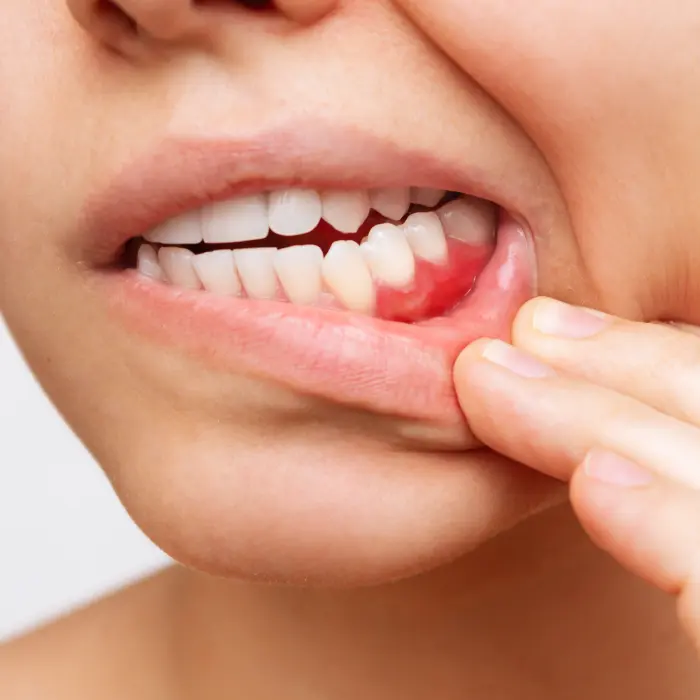
Gum recession is a condition where the gum tissue gradually moves backward, exposing the tooth root. In the early stages, it often goes unnoticed except for mild sensitivity. However, as it progresses, it can lead to serious aesthetic and health issues, such as sensitivity to hot and cold, elongated teeth, root cavities, and eventually tooth loss.
What Exactly Is Gum Recession?
It occurs when the gum pulls away from its normal position, exposing the tooth root.
The visible part of the tooth (enamel) is resistant to external factors, but the root surface is much more sensitive.
Therefore, when recession occurs:
- The tooth appears longer
- Sensitivity begins
- The root surface becomes prone to decay
- Inflammation and bleeding may occur
Gum recession does not heal on its own, so early detection is a significant advantage.
Most Common Causes of Gum Recession
Incorrect Brushing
This is the most common cause. Hard brushes, brushing too hard, and aggressive side-to-side movements can damage the gums. Over the years, the gums gradually recede.
Calculus and Inflammation
As tartar builds up, the gums become inflamed, swollen, and sensitive. When inflammation progresses, the gums pull back to protect themselves.
Genetic Predisposition
Some people naturally have thin gums. Thin gums recede more easily even with minor trauma.
Teeth Grinding – Nighttime Clenching
Excessive force on teeth strains the fibers attached to the gums, accelerating recession, especially in the lower front teeth.
Orthodontic Problems
Crowded or misaligned teeth create excessive pressure in certain areas.
Smoking
Reduces blood flow to the gums. The tissue weakens, making it more prone to recession.
Symptoms of Gum Recession
Even one of the following may indicate the beginning of gum recession:
- Sensitivity to hot or cold
- Teeth appearing longer than normal
- A difference in gum line levels
- Bleeding while brushing
- Changes in gum color and texture
- Bad breath
- Loose teeth
- Brownish spots on the root (early root decay)
These usually appear in the early stages, and if ignored, they progress.
How Is Gum Recession Diagnosed?
A dentist’s assessment includes:
- How deep is the recession?
- How many teeth are affected?
- Is the tissue thickness sufficient?
- Is the root surface exposed?
- Are there signs of tartar or inflammation?
- Are there signs of teeth grinding?
- Is there root decay?
If necessary, X-rays or 3D tomography are used to examine the bone structure. This evaluation is crucial for selecting the appropriate treatment.
Treatments for Gum Recession
Gum recession does not occur for the same reason in every patient. Therefore, treatments are personalized.
Below are the most effective and commonly applied treatments explained in patient-friendly language.
Scaling and Deep Cleaning
If inflammation is the cause, this is always the first step.
- Tartar is removed
- The root surface is smoothed
- Inflammation is reduced
- The gums begin to tighten again
In mild cases, this procedure can completely stop progression.
Proper Brushing Training
In recession caused by incorrect brushing, correcting habits constitutes a major part of treatment.
- Brush without pressing too hard
- Use a soft-bristled brush
- Brush with gentle circular movements at a 45-degree angle
- Avoid abrasive toothpaste
For most patients, even this helps prevent further recession.
Night Guard (Teeth Grinding Treatment)
If grinding accelerates recession, a night guard is essential.
- Reduces force on teeth
- Relieves fibers and gums
- Prevents new recession
- Reduces sensitivity
Gum Graft (Most Effective Solution)
For moderate and advanced recession, tissue augmentation is needed. This is the most successful method in modern dentistry.
How Is It Done?
- A small tissue is taken from the palate or special membrane
- It is placed over the receded area
- The exposed root is completely covered
Benefits
- Sensitivity disappears
- The tooth is covered with healthy gum again
- Appearance returns to natural
- Recession does not recur
This procedure gives excellent aesthetic results, especially for front teeth.
Sutureless – Minimally Invasive Methods
In some cases, small interventions suffice without traditional surgery.
Tunnel Technique
The gum is slightly lifted, and the tissue is placed underneath without damage. Healing time is shorter.
Pinhole Technique
A tiny hole is made in the gum and the tissue is shifted upward. No stitches, fast healing.
These methods are not suitable for every patient but provide natural results in appropriate cases.
What Happens If Untreated?
Gum recession does not stop on its own. If untreated:
- Root cavities increase
- Sensitivity worsens
- Aesthetics deteriorate
- Gum inflammation deepens
- Bone loss occurs
- Eventually, tooth loss can happen
Early intervention before progression provides a significant advantage.
Supportive Steps at Home
While home care alone is not a treatment, it supports the process:
- Use a soft toothbrush
- Use an interdental brush 1–2 times per week
- Brush gently without pressing
- If you smoke, consider quitting (it seriously affects healing)
- Reduce acidic drinks
- Attend regular dental check-ups
Frequently Asked Questions (Detailed Explanations)
Does gum recession heal on its own?
No, once the gum recedes, the body cannot naturally restore it to its original level. Recession can be stopped, and inflammation controlled, but lost tissue does not regenerate spontaneously.
Early steps focus on halting progression and improving gum health:
- Scaling and cleaning
- Proper brushing training
- Night guard if teeth grinding is present
- Regular check-ups
If the recession is severe and affects aesthetics and sensitivity, surgical tissue augmentation (graft) is required.
What happens if gum recession is left untreated?
Untreated gum recession silently progresses over time. Initially, only sensitivity to hot/cold is noticeable, but the condition worsens in the following years:
- Root surface becomes fully exposed – not as durable as enamel and prone to decay.
- Root cavities may develop – even fillings become more difficult, requiring special materials.
- Gum inflammation deepens – bone supporting the tooth starts to erode.
- Teeth may become loose – leading to potential tooth loss.
- Aesthetically, especially in front teeth, the “elongated” appearance becomes noticeable.
Gum recession is not just a cosmetic problem; it directly affects the lifespan of the tooth.
What is a gum graft like? Is it very difficult?
Gum grafting may sound intimidating, but modern techniques make it quite comfortable.
- Detailed examination determines which teeth are affected and the extent of recession.
- On the day of the procedure, the area is completely numbed with local anesthesia; no pain is felt.
- A small tissue is taken from the palate or prepared biological materials.
- The tissue is placed on the receded area and stitched to the gum.
- Within a few weeks, the tissue integrates as part of the gum.
For the patient:
- Procedure time is usually 30–60 minutes (depending on the number of teeth).
- Mild sensitivity may occur for 1–2 days; medications control discomfort.
- Most people resume normal daily life the next day, only protecting the area is required.
With proper planning, it provides long-lasting aesthetic and functional results.
Why is gum recession most noticeable in front teeth?
- The bone structure in front teeth is usually thinner, making them more prone to recession.
- Front teeth are most visible when smiling or talking, so visual changes are immediately noticeable.
- People who brush aggressively often brush front teeth harder and horizontally, wearing down the area.
Many think “only my front teeth have recession,” but mild recession may also be present in the back teeth. A detailed examination evaluates the entire mouth.
Why does gum recession cause sensitivity?
The visible part of the tooth (enamel) is relatively insulated from external stimuli. When gum recedes, the exposed root surface contains dentin, which is highly sensitive to external stimuli.
When gum recession occurs, you may feel brief, sharp discomfort when:
- Drinking cold water
- Drinking hot tea or coffee
- Eating sweet, sour, or acidic foods
- Even when exposed to air in some cases
This sensitivity is not just uncomfortable; it signals that the root is unprotected and emphasizes the importance of timely treatment.