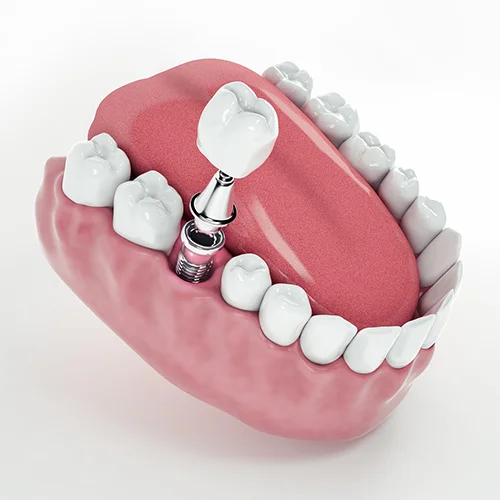
One of the most common concerns among patients considering implant treatment is whether these artificial tooth roots have any negative effect on the jawbone. Questions like “Does implant cause bone loss?” or “Will it damage my jawbone?” are quite common. In this article, we explain this topic supported by scientific data and discuss in a clear and simple way what should be considered to protect bone health.
Do Dental Implants Cause Bone Loss?
No, when done correctly, implant treatment does not harm the jawbone; on the contrary, it supports the bone.
After teeth are extracted, the jawbone loses the mechanical stimulation provided by the natural tooth root. This stimulation keeps the bone cells alive. Without this stimulus, over time bone resorption (bone loss) may develop. This situation becomes especially evident in individuals who have been toothless for a long time.
Implants integrate with the bone and provide this mechanical load again. Just like a natural tooth root, they transmit chewing forces to the bone, which stimulates and protects the bone tissue. However, for this positive effect to occur:
- Surgical procedure must be properly planned,
- An appropriate implant system must be selected,
- The patient must pay attention to oral hygiene.
Recommended content: Is It Possible to Place Implants Immediately After Tooth Extraction?
In Which Situations Can Implants Cause Bone Loss?
When applied correctly, implants support the bone; however, in some cases, bone loss around the implant may occur. This condition is called peri-implant bone resorption.
Main causes include:
- Incorrect angulation or placement of the implant,
- Implant placement despite insufficient bone volume,
- Poor oral hygiene,
- Development of peri-implantitis (explained below),
- Smoking,
- Uncontrolled systemic diseases (e.g., diabetes),
- Neglecting regular dental check-ups.
All these factors can cause inflammation of the tissues around the implant and lead to bone loss over time.
What Is Peri-Implantitis? Why Is It Important?
Peri-implantitis is inflammation of the gum and bone tissue surrounding the implant. This condition starts as peri-implant mucositis, which affects only the gum initially. If left untreated, it progresses to the bone.
Symptoms:
- Bleeding gums,
- Redness and swelling around the implant,
- Exposure of the implant (gum recession),
- Sensation of mobility (in advanced stages).
If untreated, this condition can lead to implant loss. Therefore:
- Regular dental check-ups,
- Professional cleaning,
- Proper oral hygiene at home are essential.
How Do Incorrect Implant Applications Damage the Jawbone?
Implant treatment is a serious surgical procedure and when not performed by experienced hands, it may cause damage both to the implant and surrounding bone.
Possible complications:
- Damage to anatomical structures: For example, nerve injury in the lower jaw or sinus membrane perforation in the upper jaw.
- Implant instability: An implant that does not properly integrate with the bone can move, leading to bone loss.
- Permanent bone defect: Removal of a failed implant can cause a large bone defect in the area.
- Need for larger grafts: Additional bone augmentation may be necessary for future treatments.
Therefore, implant surgery must be performed by a dental surgeon experienced in jaw surgery or implantology.
Who Has a Higher Risk of Bone Loss?
Certain individuals have a higher risk of bone loss, and special precautions should be taken before implant treatment in these patients.
Risk groups:
- Individuals who have been toothless for a long time,
- Elderly patients (especially those at risk of osteoporosis – with reduced bone density),
- Patients with bruxism (teeth grinding),
- Those with vitamin D or calcium deficiency,
- Smokers,
- Patients with a history of periodontal (gum) disease,
- Individuals with hormonal imbalances (e.g., menopause, thyroid disorders),
- Patients with a history of radiotherapy.
In these individuals, implants should not be placed directly without supportive procedures like bone grafting.
What Is Bone Grafting? When Is It Needed?
Bone grafting is a biological or synthetic filling procedure used to reconstruct the jawbone when it is insufficient. Grafting provides a healthy base for implant placement.
When is bone grafting performed?
- If bone height or thickness is insufficient,
- If the sinus cavity is excessively enlarged (especially in the upper jaw),
- If additional volume is needed for aesthetic reasons in the anterior region,
- If severe bone loss has occurred in the past.
Types of Bone Grafts
Bone grafts are used to support lost bone tissue. Their biological properties vary according to their types:
| Graft Type | Description |
|---|---|
| Autograft | Bone taken from the patient’s own body (e.g., chin, hip). It contains living cells and has the highest biological potential to generate new bone. |
| Allograft | Human donor bone obtained from cadaver donors. It is sterilized with special procedures. |
| Xenograft | Bone graft material derived from animals (usually bovine). It provides volume but does not contain living cells. |
| Alloplastic graft | Completely synthetic materials produced in the laboratory. They have low infection risk and are easy to shape. |
The choice of graft depends on the patient’s needs and the clinician’s preference.
What Should Be Considered for a Successful Implant Treatment?
Implant success is not limited to placing the implant only. Planning, application, and maintenance are an integrated process.
Important considerations:
- Detailed imaging with CBCT (cone beam computed tomography) should be performed. This device shows the jawbone in 3D and allows accurate analysis of the implant site.
- Bone quality should be evaluated according to the D1–D4 classification:
- D1: Dense cortical bone (excellent stability),
- D4: Porous, soft bone (weak support),
- The patient’s general health status must be considered,
- Surgical sterility must be strictly maintained,
- Excessive heat, pressure, or trauma should be avoided,
- Smoking and alcohol consumption should be limited,
- A patient-specific implant plan should be prepared,
- A long-term follow-up and maintenance program should be established.
Does Implant Treatment Cause Bone Loss?
No, properly planned and performed implant treatment does not cause bone loss. On the contrary, it acts like a tooth root and stimulates the jawbone, slowing bone loss. However, if risks like poor hygiene, peri-implantitis development, or surgical errors are ignored, bone loss around the implant can occur.
For a healthy and long-lasting implant:
- The procedure should be planned by an experienced surgeon,
- Preparations such as bone grafting should be made if necessary,
- The patient should maintain good oral hygiene,
- Regular dental check-ups should not be neglected.
References
- What is peri-implantitis? Lindhe J, Meyle J. (2008). Peri-implant diseases: Consensus Report of the Sixth European Workshop on Periodontology. Journal of Clinical Periodontology, 35(s8), 282–285.
- How do implants stimulate bone? Albrektsson T, Brånemark PI, Hansson HA, Lindström J. (1981). Osseointegrated titanium implants: Requirements for ensuring a long-lasting, direct bone-to-implant anchorage in man. Acta Orthopaedica Scandinavica, 52(2), 155–170.
- Bone grafts and success rates Jensen SS, Terheyden H. (2009). Bone augmentation procedures in localized defects in the alveolar ridge: clinical results with different bone grafts and bone-substitute materials. International Journal of Oral and Maxillofacial Implants, 24 Suppl, 218–236.