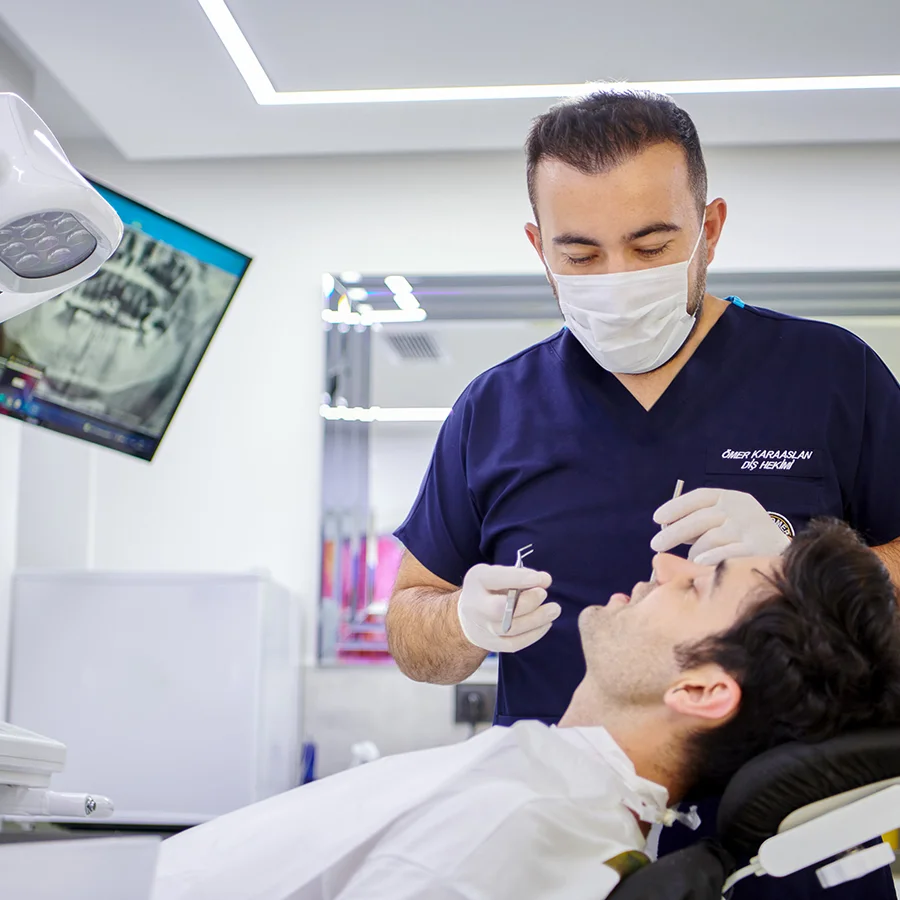
Zirconium crowns are one of the most advanced dental restoration methods that mimic the natural appearance of teeth both aesthetically and functionally. In recent years, they have become one of the most preferred solutions, especially in Hollywood Smile, cosmetic dentistry, and smile design treatments.
So how exactly is a zirconium crown applied? What are the steps, is the procedure painful, and how long does it take?
You will find the answers to all these questions step by step below.
Examination and Treatment Planning
The zirconium crown process starts, first and foremost, with a personalized examination.
At this stage, the dentist:
- Examines the structure, alignment, and bite relationship of the teeth,
- Assesses the health of the gums,
- Identifies missing, broken, or discolored teeth,
- Analyzes the jawbone and root structure with digital X-ray or 3D CBCT scanning.
Then, together with the patient, it is decided which teeth will receive crowns, the shade (color), and the desired smile design.
At this stage, the smile design is usually shown to the patient with a “mock-up” digital preview, giving them the chance to see the result before the treatment.
Goal: To prepare a plan that is aesthetically, functionally, and biologically fully compatible with the teeth.
Tooth Preparation (Reduction Stage)
Once planning is complete, the teeth that will receive zirconium crowns are prepared.
At this stage, local anesthesia is applied so the patient feels no pain or discomfort.
The dentist removes approximately 1-2 mm of enamel from the front surface of each tooth.
This is necessary for the crown to fit perfectly and look natural.
In some cases:
- If gum line alignment is needed, a gingivectomy may be performed,
- If there are cavities or old fillings, they are cleaned and renewed.
Note: In zirconium crowns, the amount of tooth removed is much less compared to porcelain veneers, preserving the tooth structure.
Digital Impression (CAD/CAM Technology)
After the teeth are prepared, impressions are taken.
Traditional silicone molds have now been replaced by digital intraoral scanners.
This technology allows:
- The teeth and gums to be scanned in 3D,
- Measurements to be obtained with millimeter accuracy,
- Error margin to be minimized,
- Crowns to be produced much faster.
The digital data is sent to the lab, and crowns are fabricated using computer-aided milling machines.
Thus, the treatment process is now conducted entirely in a digital environment.
Placement of Temporary Crowns
Until the permanent zirconium crowns are ready, the patient’s teeth are not left exposed.
Temporary crowns are placed to protect the teeth and maintain aesthetics.
These temporary teeth:
- Look naturally aesthetic,
- Maintain chewing function,
- Prevent tooth sensitivity.
The patient can continue their normal life comfortably at this stage.
Production of Zirconium Crowns
Once digital impressions reach the lab, the tooth shapes are milled from zirconium blocks using CAD/CAM systems.
Then, the dental technician applies special coloring and polishing techniques to give the crowns a natural tooth color.
Reasons for zirconium’s popularity:
- Metal-free and fully biocompatible,
- Translucent, so it shines like natural teeth,
- Highly resistant to breakage,
- Does not cause allergic reactions.
As a result, an aesthetic outcome indistinguishable from natural teeth is achieved.
Try-In and Permanent Cementation
Prepared zirconium crowns are first tried in.
At this stage, the dentist checks:
- Size and shape compatibility of the teeth,
- Alignment with the gums,
- Bite balance and chewing movements.
Minor adjustments are made if necessary. Once everything is aligned, the zirconium crowns are permanently fixed to the teeth using resin-based dental adhesives.
The patient now receives their permanent new teeth. Eating is allowed the same day, with only liquid food recommended for the first 1-2 hours.
Post-Treatment Care for Zirconium Crowns
Zirconium crowns are highly durable and long-lasting. However, proper care determines the success of the treatment.
Things to keep in mind:
- Brush teeth at least twice a day and use dental floss or interdental brushes,
- Avoid biting hard foods (e.g., ice, nuts) with the teeth,
- Have a check-up every 6 months,
- If the patient grinds their teeth at night (bruxism), use a night guard.
With proper care, zirconium crowns can last 10–20 years.
Frequently Asked Questions
Is the zirconium crown procedure painful?
No, the zirconium crown procedure is completely painless. Local anesthesia is applied before the procedure, ensuring the patient feels no discomfort. Only minimal enamel reduction is performed during tooth preparation.
After the procedure, mild hot-cold sensitivity may occur for a few days, which is normal and resolves quickly.
Additional info: Sensitivity usually comes from gum adaptation and disappears completely within a few days.
How long does zirconium crown treatment take?
The treatment duration varies depending on the patient but is generally completed within 4 to 7 days. With digital CAD/CAM systems, this can be reduced to 2–3 days.
Typical treatment plan:
- Day 1: Examination, planning, and digital impression
- Days 2–3: Placement of temporary crowns and lab process
- Days 4–5: Try-in and permanent cementation
For international patients, the process is usually planned for 3–5 days, allowing completion even during short visits to Istanbul.
Do zirconium crowns fall off or become loose?
With quality adhesives and proper tooth preparation, zirconium crowns remain stable on the tooth for many years. However, in exceptional cases (e.g., root decay, trauma, or gum recession), the crown may loosen.
In such cases:
- The crown is removed and the tooth cleaned,
- If necessary, new impressions are taken and the crown is reattached.
Important: Never try to fix a loose crown at home; it must be professionally re-cemented by a dentist.
Do zirconium crowns change color over time?
Zirconium crowns have a smooth, stain-resistant surface. Therefore, substances like tea, coffee, wine, or smoking do not cause significant color changes over time.
With proper oral care, zirconium teeth retain their original shine for years. Only slight shade differences may occur alongside natural teeth, which can be corrected with polishing.
Can zirconium crowns be applied to every patient?
They are suitable for most patients, with a few exceptions:
- Patients with active gum disease should receive gum treatment first.
- Patients with teeth grinding (bruxism) should use a special night guard.
- For patients under 18, if tooth development is incomplete, treatment may be postponed.
In other words, zirconium crowns are ideal for anyone with healthy gums and sufficient tooth structure.
Do zirconium crowns look like natural teeth?
Yes, in many cases they provide an even more aesthetic appearance than natural teeth. Zirconium reflects light like natural enamel. The crown:
- Does not appear matte or opaque,
- Blends perfectly with the gums,
- Does not create an “artificial” look in the smile.
Additionally, the tooth color is customized for the individual, so it matches adjacent teeth. This is why zirconium crowns are highly preferred, especially for front teeth aesthetics (smile design).
Natural, Bright, and Long-Lasting Smiles
Zirconium crowns are one of the safest and most modern treatment options in modern dentistry, both aesthetically and functionally. With proper planning, digital impression technology, and an experienced dentist, the result is indistinguishable from natural teeth.
If you want to see the aesthetic difference in your smile, contact Ömer Istanbul Dental Center for a free preliminary examination today.