
For an individual who has completely lost their teeth, the biggest quality-of-life issues include inability to eat, aesthetic concerns, and speech disorders. Implant treatment is currently one of the most preferred methods for permanently and durably restoring missing teeth. However, patients experiencing complete toothlessness often wonder how many implants are needed in total for the upper and lower jaws. So, how many implants are required for someone with no teeth? Here is the answer…
How Many Implants Are Needed for Someone with No Teeth?
Implant treatment for patients without any teeth offers a permanent solution that provides comfort closest to natural teeth. While patients may research some questions before and after treatment, the question “how many implants are needed for someone with no teeth” is important both for the treatment process and costs.
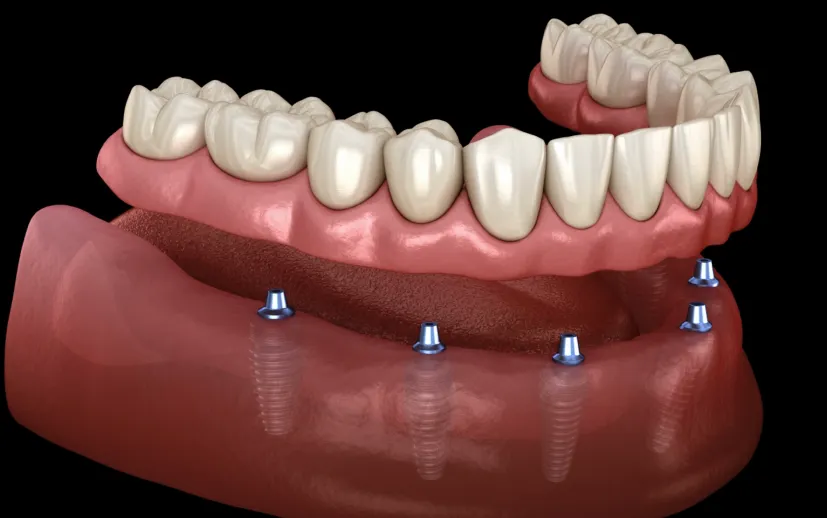
The number of implants applied to the upper and lower jaws depends on the type of prosthesis, bone density, and dentist’s recommendations. Especially in cases of full edentulism, the numbers vary depending on whether a removable or fixed prosthesis is preferred. However, in most cases, 8 implants are applied to the upper jaw and 6 implants to the lower jaw.
So, how many implants are needed for someone with no teeth? Here is the answer:
- Upper Jaw: Between 4 and 8
- Lower Jaw: Between 2 and 6
- Fixed Prosthesis: 8 implants on the upper jaw, 6 implants on the lower jaw are applied.
- Removable Prosthesis: 4 implants on the upper jaw, 2 implants on the lower jaw are applied.
- All on Four: 4 implants are placed on each jaw.
- All on Six: 6 implants are placed on each jaw.
Generally, a total of 6 to 13 implants are applied to a patient with no teeth. However, while these numbers provide a general framework, the exact count will vary entirely depending on the patient’s oral anatomy. Therefore, it is essential to have a consultation with a specialist dentist first, followed by detailed planning.
Recommended content: What Is Full Mouth Implant Treatment?
Is Implant Possible If There Are No Teeth in the Mouth?
Along with the question of how many implants are needed for someone with no teeth, there is also curiosity about whether implants can be applied in cases of full edentulism. The answer to this question, commonly asked by patients who have lost all their teeth for various reasons, is yes.
Implants can be said to be the most effective and comfortable solution for toothless mouths. Implants, which act as artificial tooth roots placed in the jawbone, enable the use of fixed or removable prostheses, making them very important.
Although the answer to “Is implant possible if there are no teeth in the mouth?” is yes, factors such as the patient’s oral health, jawbone structure, and bone density and quantity are generally considered. Having no teeth in the mouth often leads to bone loss, so these factors must be examined. If bone loss has occurred over time, this problem can be addressed with applications such as bone grafting.
Implant success directly depends on oral health and the amount of jawbone. The patient’s compliance with the treatment plan prepared by the specialist dentist is among the factors that increase success.
Is Screwless Implant Possible for Someone with No Teeth?
Along with the question of how many implants are needed for someone with no teeth, there is also interest in the recently preferred application of screwless implants. Implant treatment, by its nature, is a procedure applied with a screw system. It is not possible to apply screwless implants for individuals who are completely toothless. However, although some temporary solutions without screws exist in some removable prosthesis systems, these do not replace implant treatment.
Implant Treatments for Full Edentulism
The answer to how many implants are needed for someone with no teeth varies depending on the type of prosthesis chosen. Nowadays, implant treatments developed for patients with full edentulism generally consist of three options:
- All on Four Prosthesis
- Fixed Implant-Supported Prosthesis
- Removable Implant-Supported Prosthesis
These options are shaped according to jawbone structure, patient expectations, and needs. The All on Four treatment offers fixed teeth with fewer implants, while fixed prostheses provide the most natural chewing experience.
Recommended content: Why Are Dental Implants Removed?
1- All on Four Prosthesis
All on Four implant treatment is a practical and fixed implant technique developed for patients who have lost all their teeth. In this method, only 4 implants are placed for each jaw. These implants provide support for the prostheses to be placed later. Especially implants placed in the posterior region can be positioned at an angle using advanced surgical techniques. This minimizes the need for bone grafting and achieves a strong fixation.
Advantages of the All on Four implant treatment include:
- Requires fewer implants,
- Suitable for patients with insufficient bone density,
- Temporary teeth can be placed on the same day after the procedure,
- Offers an economical option,
- Treatment is completed in a shorter time.
Offering ideal aesthetic and functional solutions, the All on Four treatment increases comfort, especially for elderly patients. After the procedure, aesthetic appearance, chewing function, and speech ability improve significantly.
Recommended content: What to Pay Attention to After All On Four Implant Treatment?
2- Fixed Implant-Supported Prosthesis
Fixed implant-supported prostheses are a functional and aesthetic option for individuals without any teeth. These prostheses are fixed onto implants and cannot be removed by the patient. They are generally applied in two types: cemented and hybrid (screw-retained).
- Cemented fixed prostheses are glued onto the abutment placed on the implant. The patient cannot remove the prosthesis by themselves; it can only be removed by the dentist, usually by cutting the prosthesis. For a strong fixation mechanism in this method, at least 6 implants are placed per jaw.
- Hybrid fixed prostheses are screwed directly onto the implant, offering advantages. This system has been preferred recently for full edentulism due to being modern and practical. For using hybrid fixed prostheses, applying at least 4 implants per jaw is sufficient. This method is also budget-friendly because of the fewer implants and offers advantages in maintaining hygiene around implants.
Both methods are applied after evaluating the patient’s expectations, oral and jaw structure. Regular check-ups and a proper care routine by the patient will ensure the longevity of these prostheses.
3- Removable Implant-Supported Prosthesis
Removable implant-supported prostheses are structures that can be easily put on and taken off by both the patient and dentist. They are especially preferred in individuals with insufficient or weak jawbone. This method is preferred when there is not enough tissue for a fixed prosthesis and allows easy cleaning of both implants and prostheses.
Attachments form the basic structure of this prosthesis and ensure strong retention to the implants. Attachments with different types and features are generally used to keep the prosthesis stable. In cases of full edentulism, especially where bone density is insufficient, removable implant-supported prostheses provide the most suitable solution for the patient.
Recommended content: How to Relieve Pain After Implant?